

‘We find certain things about seeing puzzling,
because we do not find the whole business about seeing puzzling enough.’
Ludwig Wittgenstein
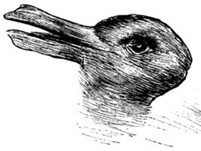

The duck-rabbit illusion is one of the most famous bistable images, where some people see a duck and others a rabbit. It was first published in 1892 by a German humour magazine (oxymoron). But it was half a century later that the Austrian-British Philosopher Ludwig Wittgenstein gave the duck-rabbit its enduring notoriety and fame.
Wittgenstein used the image to illustrate how the same raw visual data can be seen and perceived differently. How the meaning of an image or word is not singular and static, but a fluid process of interpretation and contextualized perception.
Wittgenstein focused on applying these principles to language and linguistics, but his arguments have much broader philosophical implications. And in a time when the same information and data can invoke opposing, and often divisive, views, the duck-rabbit seems an apt metaphor, and one that can offer us some insights and wisdom.
The dot plot thickens.
Along with the duck-rabbit, Wittgenstein used another simple image to illustrate his point.
In this instance, the viewer can interpret the image in a multitude of ways: as a group of dots, as four individual dots, as two middle dots flanked by two singles… Another example of how the same inputs are open to multiple, valid interpretations.
Today, it is another set of ambiguous dots that is preoccupying investors: the fabled Fed dot plot. Most of the time, central bankers agree on the interpretation of economic data and the appropriate monetary policy response.
But over the past five FOMC meetings, there has been dissent, with differing opinions on the appropriate level of the policy rate. As with Wittengenstien’s dots, depending on the lens through which they are viewed, the same inputs and data lead to different interpretations and conclusions.
The dove-hawk.
On our side of the border, the BoC seems to have its ducks in a row, with the consistent message of staying on hold (for the time being). But bond investors are divided on their next move.
The market is tilting towards a hike later this year/early next, on the back of a stronger-than-expected labour market and the proposed fiscal stimulus. Meanwhile, others point to easing inflation, concerns about growth, and the uncertainty of US trade policy as reasons the BoC will need to cut rates further.
Thus, it seems that on both sides of the border, interest rate policy finds itself in a duck-rabbit predicament, or more appropriately, a dove-hawk situation.
Beyond dualism.
When faced with conflicting views, the natural tendency is to avoid uncertainty and gravitate towards one side. An inclination exacerbated by media algorithms and the constant flood of news. As the modern cultural theorist and philosopher Byung-Chul Han notes, ‘adrift in the sea of information and data, we seek a narrative anchor’.
Anchoring oneself and picking a side alleviates the discomfort of uncertainty, but in doing so, we run the risk of ‘aspect blindness’. The term Wittengenstein used for the inability to shift between perspectives, such as a person who only sees the duck and can not see the rabbit.
The proposed remedy is to break free from a dualistic framing of the world, away from right-wrong, true-false, black-white. After all, one man’s duck is another man’s rabbit, and neither is right nor wrong. And as investors, it is always best to consider different perspectives and see the full picture.
The Month of January.
Credit.
Credit markets shrugged off geopolitical risks, tariff threats, and the deep Arctic cold to start the year red hot. Primary markets set January records, with $16.5 bn of corporate issuance in Canada and $224 bn in the US. Of note in the domestic market, TD issued the largest bail-in deal at $3 bn, with CIBC following shortly thereafter with a $3 bn deal of their own.
Despite record-breaking issuance, the supply fell short of demand. With strong inflows into fixed income and cash reserves built up from December, bond buyers were out in full force. Not only were the new issues digested with ease, but a lack of sellers forced investors to pick away at light dealer inventories, leading to secondary spreads grinding tighter.
Investment-grade credit spreads:
- Canadian spreads narrowed 6 bps to 78 bps.
- US spreads widened 5 bps to 73 bps.
Interest Rates.
As expected, the BoC held the overnight rate at 2.25%. The accompanying statement and press conference were a whole lot of, ‘we’re not moving rates anytime soon’.
South of the border, the FOMC maintained its target range for the policy rate at 3.5%-3.75%. The vote had two dissenters, with Governors Waller and Miran, in favour of a 25 bps cut.
The big news was the conclusion of the ‘Apprentice Fed Edition’ with Kevin Warsh chosen as the next Chair. The announcement had a de minimis impact on yields, as the market views him as a credible pick (for now).
With the central banks following the market’s script and no material changes in the economic data, rates traded in a narrow range, with Canadian and US yields finishing a few bps on either side of unchanged.
- Canadian 2y finished at 2.55% (-3 bps) and the 10y at 3.42% (- 2 bps)
- US 2y finished at 3.52% (+5 bps) and the 10y at 4.24% (+7 bps)
The Funds.
Algonquin Debt Strategies Fund.
Despite being underweight credit, the Fund participated in the rally through tactical risk adjustments and active trading. With spreads trading at the tight end of their range, we continue to trade from a conservative risk posture, focusing on idiosyncratic and tactical opportunities.
Portfolio Metrics:
- 4-6% yield
- Average credit rating: BBB+
- Average maturity: 2.2y
- IR Duration: 1.9y
| 1M | 3M | 6M | YTD | 1Y | 3Y | 5Y | 10Y | SI | |
| X Class | 0.86% | 1.41% | 2.70% | 0.86% | 4.97% | 8.69% | 5.64% | 7.35% | 8.12% |
| F Class | 0.76% | 1.20% | 2.29% | 0.76% | 4.17% | 7.62% | 4.79% | NA | NA |
* As of January 31st, 2026
The Algonquin Debt Strategies Fund LP was launched on February 2, 2015. Returns are shown on ‘Series 1 X Founder’s Class’ since inception and for ‘Series 1 F Class’ since May 1st, 2016, and are based on NAVs in Canadian dollars as calculated by SGGG Fund Services Inc. net of all fees and expenses. For periods greater than one year, returns are annualized.
Algonquin Fixed Income 2.0
With US and CAD rates trading in a narrow range, the January return was driven by opportunities in the credit market. Corporate positions were rotated through profit-taking and participation in the new-issue market, while interest-rate exposures remain concentrated in 2-5y yields.
Portfolio Metrics:
- 3.5%-4.5% yield
- Average credit rating: A-
- Average maturity: 2.6y
- IR Duration: 4.6y
| 1M | 3M | 6M | YTD | 1Y | 2y | 3y | 5y | SI | |
| F Class | 0.73% | 0.82% | 3.19% | 0.73% | 5.27% | 7.60% | 7.44% | 4.08% | 5.12% |
* As of January 31st, 2026
Algonquin Fixed Income 2.0 Fund is an Alternative Mutual Fund and was launched on December 9, 2019. Returns are shown for Class F since inception and are based on NAVs in Canadian dollars as calculated by SGGG Fund Services Inc., net of all fees and expenses. Investors should read the Simplified Prospectus, Annual Information Form, and Fund Facts Documents and consult their registered investment dealer before making an investment decision. Commissions, trailing commissions, management fees, and operating expenses all may be associated with mutual fund investments. An Alternative Mutual Fund is not guaranteed, its value changes frequently and its past performance is not indicative of future performance and may not be repeated. Payment of quarterly distributions is not guaranteed and paid at the discretion of the manager; therefore, it may vary from period to period and does not infer fund performance or rate of return.
Looking Ahead.
Given the strong inflows into fixed income, we expect the demand for investment-grade debt to remain strong despite growing concerns in some segments of the economy. After propelling equity indices higher in 2025, AI has been at the centre of these concerns.
First of all, investment activity has led to greater use of all forms of debt, bringing greater scrutiny to the timing of when these investments will generate cash flow. The other areas of focus are the sectors that AI is disrupting, such as software.
We see more analysts fretting over whether software companies have a true moat around their businesses, questioning the long-term stability of cash flows, and wondering whether the companies may have too much debt.
Because much of this debt is in the private credit and loan markets, it is difficult to get much real-time information on the situation. While this might prove to be a ‘tempest in a teacup,’ with credit spreads at the narrow end of the range, we are maintaining a low exposure with a concentration in higher-quality, more liquid names.
Canadian yields remain mired in a narrow range. Once again, the BoC signalled it is on hold, believing that rates are at the appropriate level to maintain inflation at 2% while supporting economic growth.
Bond traders are leaning toward a hike late this year. Between then and now, we have the CUSMA renegotiations. Until there is greater clarity on what a trade deal entails, we expect rates to trade in a narrow range.
The US bond market is far more interesting. Kevin Warsh has been selected to succeed Jerome Powell as Chairman of the Federal Reserve. Despite being President Trump’s pick, the reaction from the bond traders was muted. Bond traders continue to expect 50b ps of cuts this year, with the whole move happening after Chairman Powell’s tenure ends.
The reason that the majority of FOMC members remain in ‘rate cut’ mode is that they believe that deregulation, tax cuts, and AI are boosting the ‘supply’ of goods and services and creating a disinflationary tailwind. Adding to the disinflationary pressure is emerging weakness in the labour market. Those in Chairman Powell’s camp would like to see evidence of disinflation in the CPI data before cutting rates. Kevin Warsh is a believer in conducting monetary policy based on forecasts (similar to the Bank of Canada’s approach) and would likely be cutting rates now. We do not know how many cuts he believes are necessary, but it seems reasonable to assume a policy rate close to 3%.
The other interesting item to watch is what Warsh does with the Fed’s balance sheet, which remains full of Treasury and mortgage-backed securities. He is not a fan of quantitative easing as he believes it inflates asset prices, which does little to help the average American. Instead, he thinks that increasing bank lending is a better way to stimulate the economy. Achieving this outcome requires a lower and steeper yield curve and less bank regulation.
From a duration perspective, we think it makes sense to have exposure to the short end of both yield curves. The domestic positions serve as a hedge against a bad CUSMA outcome, and the US duration is based on the expectation that Warsh (and the administration) will swing the majority of the committee to his way of thinking.


